Knowledge discovery & ML prototypes

Discover patterns and rules in complex data and develop an ML prototype.

Your challenge

You need to identify which groups, anomalies or relationships in your data matter for a specific business question. Numerous variables and inconsistent data make those relationships difficult to detect.

How IAP approaches it

IAP examines data quality, distributions and relationships between variables. Clustering and projections reveal groups and outliers. Together with your experts, we determine which structures address the business question and which assumptions need further investigation.

Project deliverables

You receive an analysis of relevant patterns, visualisations and an evaluation of what can be achieved with your data. A subsequent ML prototype can use the identified relationships for classification or forecasting. Its evaluation helps determine whether further development is worthwhile for your task.

Read the technical detail ↓

Methods and technical detail

Understand the data before building a model

Start by examining data quality, representativeness and the relevance of individual variables to the business objective. Density estimation describes concentrations of observations and possible subpopulations. Appropriate similarity and distance measures determine which cases can meaningfully be compared.

Translate structures into a useful method

Clustering, projection and analysis of relationships between variables can reveal groups, outliers and useful features. Depending on the task, these can support classifiers for categories, regressors for numerical values or forecasting methods. Domain interpretation and evaluation on held-out data inform the assessment.

Extract explicit knowledge

Symbolic methods translate suitable patterns into rules that experts can review. Fuzzy logic can describe gradual membership; predicate logic can express conditions and relationships explicitly. The objective is knowledge that experts can inspect and use in decision support. New findings feed iteratively back into data preparation and method selection.

Methodological sources

Behnisch, M. & Ultsch, A. (2015). Knowledge Discovery in Spatial Planning Data: A Concept for Cluster Understanding. In: Computational Approaches for Urban Environments, pp. 49–75. Springer.

Describes the path from data assessment and clustering to understandable rules and knowledge that domain experts can use.

López-García, P. A., Argote, D. L., Torres-García, M. A. & Thrun, M. C. (2024). Knowledge Discovery from Archaeological Materials. Elements in Current Archaeological Tools and Techniques. Cambridge University Press.

Connects methods of knowledge discovery and classification with their application to archaeological materials.

Thrun, M. C. & Ultsch, A. (2020). Swarm-Based Cluster Analysis for Knowledge Discovery. In: Schmid, U., Klügl, F. & Wolter, D. (eds.), KI 2020: Advances in Artificial Intelligence. Lecture Notes in Computer Science, Vol. 12325, pp. 240–244. Springer.

Swarm-based clustering to discover groups in data.

Thrun, M. C. (2022). Exploiting Distance-Based Structures in Data Using an Explainable AI for Stock Picking. Information, 13(2), 51. MDPI.

Shows how distance-based data structures can be translated into explainable decision rules and examined for stock selection.

Iterative knowledge-discovery process
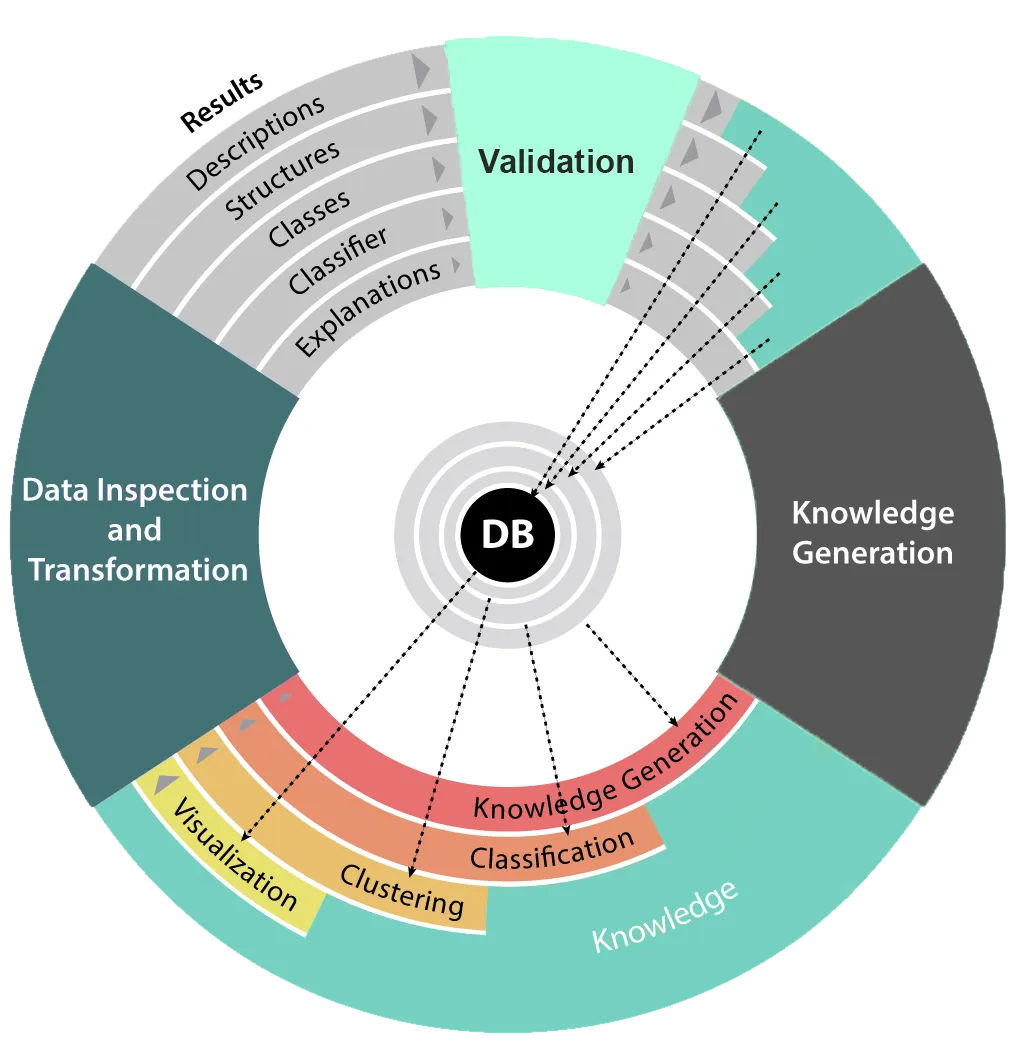
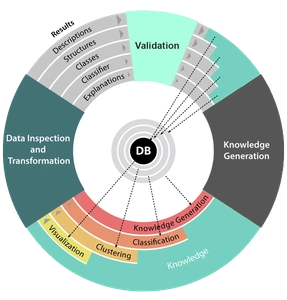
IAP process diagram: data inspection, structure discovery, classification and knowledge generation are repeatedly validated. New knowledge informs subsequent analysis.

Projects related to this service

Allview.com

Collaborative project · Proof of Concept (PoC)

Interpretable rules for stock selection

Company fundamentals were to support systematic stock selection that people could inspect.

Project details →
Universitätsklinikum & Philipps-Universität Marburg

Hospital prototype · collaborative research

Sample quality and high-dimensional biomedical data

The quality of blood and bone-marrow samples affects interpretation. Dilution and complex cell populations need to be considered in the analysis.

Project details →
LANCOM Systems

Data analysis · further method development

Web and CRM data for sales analysis

How does use of a company website relate to later project enquiries? The analysis for LANCOM Systems examined browsing behaviour alongside associated project information.

Project details →
The Body Shop

Feasibility assessment · scoping

AI feasibility assessment for retail

Which marketing and merchandise-planning tasks are suitable for targeted use of AI? The Body Shop needed an assessment of potential applications and the prerequisites for implementing them.

Project details →

The right form of handover

Option 1

Prototype for your IT team

IAP investigates the problem, develops and evaluates the approach, and hands over the agreed prototype with documentation. Your IT team takes responsibility for further product development and operation.

Option 2

Application through integration

IAP develops the agreed application, including its interface and integrations, connects it to the intended workflow, and completes acceptance and handover. Your organisation or operating partner takes responsibility for subsequent operation.

Which decision do you want to improve?

In a free, non-binding 20-minute introductory discussion, we clarify your objective, starting point and a useful next step.

Request an introductory discussion